
Setting the Record Straight
July 4, 2017
Setting the Record Straight
Published: 2002
“Setting the Record Straight,” Appendix B of the book “The Miracle of Islamic Science.” In this appendix, Dr. K. Ajram lists hundreds of scientific and intellectual discoveries and achievements made by Muslims. Still, neither Muslims nor Arabs were acknowledged for them. We posted “Appendix B,” as a whole, for our reader’s convenience.
Appendix B
Most people still unquestioningly accept the idea that science is exclusively the product of Western minds. Any standard text or encyclopedia on the history of science would support this view. As readers peruse these books, they see that they mention only Europeans and/or Americans. It is hardly necessary to repeat the oft-mentioned names: Galileo, Copernicus, Kepler, Bacon, Newton, Da Vinci, Benjamin Franklin, etc.
The unavoidable conclusion is that other cultures contributed little to the development of modern science. Most texts mention little or nothing about the advancements made by ancient Indian, Chinese, or, particularly, Muslim scholars.
Western civilization has made invaluable contributions to scientific development. However, so have numerous other cultures.
Unfortunately, Westerners have long been credited with discoveries Islamic scholars made centuries earlier. Thus, non-Europeans invented many of the basic sciences. For instance, George Sarton states that modern Western medicine did not originate in Europe but arose from the (Islamic) Orient.
The data in this section on dates, names, and topics of Western advances comes from three main sources: World Book Encyclopedia, Encyclopedia Britannica, and Isaac Asimov’s 700-page book, Chronology of Science and Discovery. Supportive data on Islamic scholars’ accomplishments come from the miscellaneous references listed in this book’s bibliography.
What is Taught:
Roger Bacon first mentioned the man in flight and drew a flying apparatus. Leonardo da Vinci also conceived of airborne transport and drew several prototypes.
What Should be Taught:
Ibn Firnas of Islamic Spain invented, constructed, and tested the flying machine in the 800’s A.D. Roger Bacon learned of flying machines from Arabic references to Ibn Firnas’ machine. The latter’s invention predates Bacon by 500 years and Da Vinci by some 700 years.
What is Taught:
Venetians first produced glass mirrors in 1291.
What Should be Taught:
Islamic Spain used glass mirrors as early as the 11th century. The Venetians learned of fine glass production from Syrian artisans during the 9th and 10th centuries.
What is Taught:
Until the 14th century, the only type of clock available was the water clock. In 1335, Milan, Italy, saw the erection of a large mechanical clock. This was possibly the first weight-driven clock.
What Should be Taught:
Spanish Muslim engineers produced a variety of mechanical clocks, both large and small, and this knowledge spread to Europe through Latin translations of Islamic books on mechanics. These clocks were weight-driven. They included designs and illustrations of epicyclic and segmental gears. One such clock included a mercury escapement. Europeans directly copied this type in the 15th century. Besides, during the 9th century, Ibn Firnas of Islamic Spain, according to Will Durant, invented a watch-like device that kept accurate time. The Muslims also constructed a variety of highly accurate astronomical clocks for use in their observatories.
What is Taught:
In the 17th century, Galileo developed the pendulum as a teenager. He noticed a chandelier swaying in the wind. As a result, he went home and invented the pendulum.
What Should be Taught:
Ibn Yunus al-Masri discovered the pendulum during the 10th century and was the first to study and document its oscillatory motion. Muslim physicists introduced its value for use in clocks during the 15th century.
What is Taught:
Johannes Gutenberg of Germany invented movable type and the printing press in the West during the 15th century.
What Should be Taught:
In 1454, Gutenberg developed the most sophisticated printing press of the Middle Ages. However, Islamic Spain had used movable brass type 100 years earlier, when the West’s first printing devices were made.
What is Taught:
Isaac Newton’s 17th-century study of lenses, light, and prisms laid the foundation for modern optics.
What Should be Taught:
In the 1lth century, al-Haytham determined virtually everything that Newton advanced regarding optics centuries prior and is regarded by numerous authorities as the “founder of optics. ” There is little doubt that he influenced Newton. Al-Haytham was the most quoted physicist of the Middle Ages. European scholars quoted his works in the 16th and 17th centuries more than Newton and Galileo combined.
What is Taught:
In the 17th century, Isaac Newton discovered that white light consists of various colored rays.
What Should Be Taught: Al-Haytham (11th century) and Kamal ad-Din (14th century) made this discovery in its entirety. Newton did make original discoveries, but this was not one of them.
What is Taught:
Antoine Lavoisier first introduced the concept of matter’s finite nature in the 18th century. He discovered that although matter may change form or shape, its mass remains the same. Thus, whether water is heated to steam, salt dissolves in water, or a piece of wood burns to ashes, the total mass remains unchanged.
What Should be Taught:
Islamic Persia’s great scholar al-Biruni (d. 1050) elaborated on these principles centuries earlier. Lavoisier studied under Muslim chemists and physicists and often referenced their books.
What is Taught:
The Greeks developed trigonometry.
What Should be Taught:
The Greeks kept trigonometry largely theoretical. Muslim scholars developed it to a level of modern perfection, though al-Battani deserves credit. The terms describing this science’s basic functions, sine, cosine, and tangent, derive from Arabic. Thus, the Greeks contributed little to trigonometry.
What is Taught:
A Dutchman, Simon Stevin, first developed decimal fractions in 1589. He advanced mathematics by replacing cumbersome fractions, such as 1/2, with decimal fractions, such as 0.5.
What Should be Taught:
Muslim mathematicians were the first to utilize decimals instead of fractions on a large scale. Al-Kashi’s book, Key to Arithmetic, was written at the beginning of the 15th century and spurred the systematic use of decimals for whole numbers and fractions. Stevin probably imported the idea to Europe from al-Kashi’s work.
What is Taught:
The first man to utilize algebraic symbols was the French mathematician François Viète. In 1591, he wrote an algebra book describing equations with letters such as the now familiar x and y’s. Asimov says that this discovery had an impact similar to the progression from Roman numerals to Arabic numbers.
What Should be Taught:
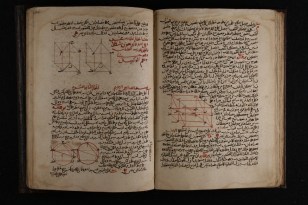
Muslim mathematicians, the inventors of algebra, used letters for unknown variables in equations as early as the 9th century A.D. With this system, they solved a variety of complex equations, including quadratic and cubic equations. They used symbols to develop and perfect the binomial theorem.
What is Taught:
Cubic equations (x to the third power) remained unsolved until the 16th century, when Niccolò Tartaglia, an Italian mathematician, solved them.
What Should be Taught:
Muslim mathematicians solved cubic equations and many higher-degree equations with ease as early as the 10th century.
What is Taught:
The concept that numbers could be less than zero, that is, negative numbers, was unknown until 1545 when Geronimo Cardano introduced it.
What Should be Taught:
Muslim mathematicians used negative numbers in various arithmetic functions at least 400 years before Cardano.
What is Taught:
In 1614, John Napier invented logarithms and logarithmic tables.
What Should be Taught:
Muslim mathematicians invented logarithms and produced logarithmic tables several centuries prior. Such tables were common in the Islamic world as early as the 13th century.
What is Taught:
In the 17th century, René Descartes discovered that algebra could solve geometrical problems. This greatly advanced geometry.
What Should be Taught:
Mathematicians of the Islamic Empire accomplished precisely this as early as the 9th century A.D. Thabit bin Qurrah was the first to do so. Abu’l Wafa followed, and his 10th-century book used algebra to make geometry an exact, simplified science.
What is Taught:
In the 17th century, Isaac Newton developed the binomial theorem, a crucial component of algebra.
What Should be Taught:
Muslim mathematicians used and perfected the binomial theorem. They began using it to systematically solve algebraic problems in the 10th century (or earlier).
What is Taught:
The ancients made no improvements to astronomy during the Middle Ages regarding planetary motion until the 13th century. Then Alphonso the Wise of Castile (Middle Spain) invented the Alphonsine Tables, which were more accurate than Ptolemy’s.
What Should be Taught:
Muslim astronomers improved upon Ptolemy’s findings as early as the 9th century. They were the first astronomers to dispute his archaic ideas. In their critique of the Greeks, they synthesized proof that the sun is the center of the solar system and that the orbits of the Earth and other planets might be elliptical. They produced hundreds of highly accurate astronomical tables and star charts. Many of their calculations are so precise that they are regarded as contemporary. The Alphonsine Tables are little more than copies of astronomical works transmitted to Europe via Islamic Spain, i.e., the Toledo Tables.
What is Taught:
The English scholar Roger Bacon (d. 1292) first mentioned glass lenses for improving vision. At nearly the same time, people in both China and Europe used eyeglasses.
What Should be Taught:
Ibn Firnas of Islamic Spain invented eyeglasses in the 9th century, and people manufactured and sold them throughout Spain for over two centuries. Roger Bacon’s mention of eyeglasses was simply a regurgitation of al-Haytham’s (d. 1039) work, which Bacon frequently cited.
What is Taught:
The Western world developed gunpowder in 1242 as a result of Roger Bacon’s work. The first usage of gunpowder in weapons was when the Chinese fired it from bamboo shoots to frighten Mongol conquerors. They produced it by mixing sulfur, charcoal, and saltpeter.
What Should be Taught:
The Chinese developed saltpeter for fireworks and had no tactical military use for gunpowder, nor did they invent its formula. Research by Reinuad and Fave has clearly shown that Muslim chemists initially formulated gunpowder. Further, these historians claim that the Muslims developed the first firearms. Notably, Muslim armies used grenades and other weapons to defend Al-Andalus against the Franks in the 14th century. Jean Mathes indicates that the Muslim rulers had stockpiles of grenades, rifles, crude cannons, incendiary devices, sulfur bombs, and pistols decades before such devices were used in Europe. The first mention of a cannon appears in an Arabic text around 1300 A.D. Roger Bacon learned the gunpowder formula from Latin translations of Arabic books. He brought forth nothing original in this regard.
What is Taught:
The Chinese invented the compass, which may have been the first to use it for navigational purposes sometime between 1000 and 1100 A.D. The earliest reference to its use in navigation comes from the Englishman Alexander Neckam (1157-1217).
What Should be Taught:
Muslim geographers and navigators learned of the magnetic needle, possibly from the Chinese, and were the first to use it for navigation. They invented the compass and passed the knowledge of its use in navigation to the West. European navigators relied on Muslim pilots and their instruments when exploring unknown territories. Gustav Le Bon claims that the Muslims entirely invented the magnetic needle and the compass and that the Chinese had little to do with it. Neckam, like the Chinese, probably learned about it from Muslim traders. Notably, the Chinese improved their navigational expertise after interacting with the Muslims in the 8th century.
What is Taught:
The first man to classify the races was the German Johann F. Blumenbach, who divided humanity into white, yellow, brown, black, and red peoples.
What Should be Taught:
Muslim scholars of the 9th through 14th centuries invented the science of ethnography. Several Muslim geographers classified the races, writing detailed explanations of their unique cultural habits and physical appearances. They wrote thousands of pages on this subject. Blumenbach’s works were insignificant in comparison.
What is Taught:
The science of geography was revived during the 15th, 16th, and 17th centuries when scholars rediscovered Ptolemy’s ancient works. The Crusades and the Portuguese/Spanish expeditions also contributed to this reawakening. The first scientifically based treatise on geography was produced during this period by European scholars.
What Should be Taught:
Muslim geographers produced countless books on the geography of Africa, Asia, India, China, and the Indies from the 8th through the 15th centuries. These writings included the world’s first geographical encyclopedias, almanacs, and road maps. Ibn Battutah’s 14th-century masterpieces provide a detailed view of the ancient world’s geography. Muslim geographers from the 10th through the 15th centuries far exceeded European output on these regions well into the 18th century. The Crusades destroyed educational institutions, scholars, and books. They brought nothing substantive to the Western world in terms of geography.
What is Taught:
Robert Boyle founded modern chemistry in the 17th century.
What Should be Taught:
Many Muslim chemists, including ar-Razi, al-Jabr, al-Biruni, and al-Kindi, conducted chemical experiments about 700 years before Boyle. Durant writes that the Muslims introduced the experimental method to this science. Humboldt regards the Muslims as the founders of chemistry.
What is Taught:
Leonardo da Vinci (16th century) fathered geology when he noted that fossils found on mountains indicated the earth’s watery origin.
What Should be Taught:
Al-Biruni (11th century) made this observation more precisely and built on it, including a major book on geology, hundreds of years before Da Vinci was born. Ibn Sina noted this as well (see pages 100-101). Da Vinci likely first learned of this concept from Latin translations of Islamic books. He added nothing original to their findings.
What is Taught:
The first mention of valleys’ geological formation came in 1756, when Nicolas Desmarest proposed that streams formed them over a long period of time.
What Should be Taught:
Ibn Sina and al-Biruni made this discovery in the 11th century, 700 years before Desmarest.
What is Taught:
Galileo (17th century) was the world’s first great experimenter.
What Should be Taught:
Al-Biruni (d. 1050) was the world’s first great experimenter. He wrote over 200 books, many of which discuss his precise experiments. His scientific output amounts to about 13,000 pages, far exceeding what Galileo or, for that matter, Galileo and Newton combined wrote.
What is Taught:
The Italian Giovanni Morgagni is regarded as the father of pathology because he was the first to correctly describe the nature of disease.
What Should be Taught:
Islam’s surgeons were the first pathologists. They fully understood the nature of disease and described a variety of conditions in modern detail. Ibn Zuhr accurately described pleurisy, tuberculosis, and pericarditis. Az-Zahrawi accurately documented the pathology of hydrocephalus (water on the brain) and other congenital diseases. Ibn al-Quff and Ibn an-Nafs accurately described circulatory diseases. Other Muslim surgeons gave the first accurate descriptions of certain malignancies, including cancer of the stomach, bowel, and esophagus. These surgeons originated pathology, not Giovanni Morgagni.
What is Taught:
Paul Ehrlich (19th century) is credited with originating chemotherapy, which uses specific drugs to kill microbes.
What Should be Taught:
Muslim physicians used a variety of specific substances to destroy microbes. They applied sulfur topically specifically to kill the scabies mite. Ar-Razi (10th century) used mercurial compounds as topical antiseptics.
What is Taught:
Arnau de Villanova, a Spanish alchemist, first produced purified alcohol through distillation in 1300 A.D.
What Should be Taught:
Muslim chemists produced medicinal-grade alcohol through distillation as early as the 10th century and built the first large-scale distillation devices for chemical use. They used alcohol as a solvent and antiseptic.
What is Taught:
C.W. Long, an American, performed the first surgery under inhalation anesthesia in 1845.
What Should be Taught:
Six hundred years before Long, Islamic Spain’s Az-Zahrawi and Ibn Zuhr, among other Muslim surgeons, performed hundreds of surgeries under inhalation anesthesia using narcotic-soaked sponges placed over the face.
What is Taught:
During the 16th century, Paracelsus invented the use of opium extracts for anesthesia.
What Should be Taught:
Muslim physicians introduced the anesthetic value of opium derivatives during the Middle Ages. Opium was originally used as an anesthetic agent by the Greeks. Paracelus studied Ibn Sina’s works, and he almost certainly derived this idea from them.
What is Taught:
Modern anesthesia was invented in the 19th century by Humphrey Davy and Horace Wells.
What Should be Taught:
Muslim anesthetists discovered, mastered, and perfected modern anesthesia 900 years before Davy and Wells. They used oral and inhalant anesthetics.
What is Taught:
People first developed the concept of quarantine in 1403. In Venice, a law prevented strangers from entering the city until a set waiting period had passed. If no signs of illness were found by then, they were allowed in.
What Should be Taught:
The Prophet Muhammad first introduced the concept of quarantine in the 7th century A.D., wisely warning against entering or leaving a region suffering from the plague. As early as the 10th century, Muslim physicians innovated isolation wards for individuals suffering from communicable diseases.
What is Taught:
The British surgeon Joseph Lister discovered the scientific use of antiseptics in surgery in 1865.
What Should be Taught:
As early as the 10th century, Muslim physicians and surgeons used purified alcohol to treat wounds as an antiseptic. Surgeons in Islamic Spain utilized special methods for maintaining antisepsis before and during surgery. They also originated specific protocols for maintaining hygiene during the post-operative period. Their success rate was so high that dignitaries throughout Europe came to Cordova, Spain, to be treated, comparing it to the “Mayo Clinic” of the Middle Ages.
What is Taught:
In 1545, the French surgeon Ambroise Paré advanced the scientific use of surgery. Before him, surgeons attempted to stop bleeding through the gruesome procedure of searing the wound with boiling oil. Paré stopped using boiling oil and began ligating arteries. He is considered the “father of rational surgery.” Pare was also one of the first Europeans to condemn such grotesque “surgical” procedures as trepanning (see reference #6, pg. 110).
What Should be Taught:
Islamic Spain’s illustrious surgeon, az-Zahrawi (d. 1013), began ligating arteries with fine sutures over 500 years before Pare. He perfected the use of Catgut, which is a suture made from animal intestines. He also introduced cotton and wax to plug bleeding wounds.
Europeans gained access to full details of his work through Latin translations. Despite this, barbers and herdsmen remained the primary practitioners of the “art” of surgery for nearly six centuries after az-Zahrawi’s death. He was a barber himself, though more skilled and conscientious than the average. Az-Zahrawi left behind dozens of books.
His most famous work is a 30-volume treatise on medicine and surgery. His books cover preventive medicine, nutrition, cosmetics, drug therapy, surgical technique, anesthesia, pre- and post-operative care, and include drawings of about 200 surgical devices, many of which he invented. The refined and scholarly az-Zahrawi must be regarded as the father and founder of rational surgery, not the uneducated Pare.
What is Taught:
In the early 17th century, William Harvey discovered that blood circulates. He was the first to correctly describe how the heart, arteries, and veins function. Rome’s Galen presented erroneous ideas about the circulatory system, and Harvey was the first to show that the heart pumps blood throughout the body via the venous valves. Therefore, he is regarded as the founder of human physiology.
What Should be Taught:
In the 10th century, Islam’s ar-Razi wrote an in-depth treatise on the venous system, accurately describing the veins’ function and their valves. Ibn an-Nafs and Ibn al-Quff (13th century) provided comprehensive documentation that blood circulates and correctly described the heart’s physiology and valve function 300 years before Harvey. William Harvey graduated from Italy’s famous Padua University, where much of the curriculum was based on Ibn Sina’s and ar-Razi’s textbooks.
What is Taught
A German scholar published the first pharmacopeia (book of medicines) in 1542. According to World Book Encyclopedia, pharmacology began in the 1900s as an offshoot of chemistry, based on analyzing crude plant materials. After isolating active ingredients from plants, chemists recognized their medicinal value.
What Should be Taught:
According to the eminent scholar of Arab history, Phillip Hitti, the Muslims, not the Greeks or Europeans, wrote the first “modern” pharmacopeia. Muslim physicians originated pharmacology in the 9th century. They developed it into a highly refined, precise science. Muslim chemists, pharmacists, and physicians produced thousands of drugs and/or crude herbal extracts one thousand years before the supposed birth of pharmacology. In the 14th century, Ibn Baytar wrote a monumental pharmacopeia listing about 1,400 different drugs. Hundreds of other pharmacopeias were published during the Islamic Era. The German work likely derives from Ibn Baytar’s, which circulated widely in Europe.
What is Taught:
Paracelsus, the Swiss-born physician, discovered the scientific use of drugs to treat specific diseases during the 16th century. He is also credited with being the first to use practical experience as a key factor in patient treatment rather than relying exclusively on the ancients’ works.
What Should be Taught:
Ar-Razi, Ibn Sina, al-Kindi, Ibn Rushd, az-Zahrawi, Ibn Zuhr, Ibn Baytar, Ibn al-Jazzar, Ibn Juljul, Ibn al-Quff, Ibn an-Nafs, al-Biruni, Ibn Sahl, and hundreds of other Muslim physicians mastered drug therapy to treat specific symptoms and diseases. In fact, they coined the term. The word “drug” is derived from Arabic. They relied heavily on practical experience and careful observation. Muslim physicians were the first to criticize ancient medical theories and practices. Ar-Razi devoted an entire book to critiquing Galen’s anatomy. Paracelsus’s works are insignificant compared with the vast volumes of medical writing and original findings produced by the medical giants of Islam.
What is Taught:
A German, Johann Weger, developed the first sound approach to treating disease in the 1500s.
What Should be Taught:
Harvard’s George Sarton says modern medicine is entirely an Islamic development and that Muslim physicians from the 9th through the 12th centuries were precise, scientific, rational, and sound in their approach. Johann Weger was one of thousands of European physicians from the 15th through the 17th centuries who were taught ar-Razi and Ibn Sina’s medicine. He contributed nothing original.
What is Taught:
Philippe Pinel modernized medical treatment for the insane when he opened France’s first asylum for the insane in 1793.
What Should be Taught:
As early as the 1lth century, Islamic hospitals maintained special wards for the insane. They treated them kindly and presumed their disease was real at a time when the insane were routinely burned alive in Europe as witches and sorcerers. A curative approach was taken for mental illness, and, for the first time in history, the mentally ill were treated with supportive care, drugs, and psychotherapy. Every major Islamic city maintained an insane asylum where patients were treated at no charge. In fact, the Islamic system for the treatment of the insane excels compared to the current model, as it was more humane and highly effective.
What is Taught: The Englishman Abraham Gesner first produced kerosene in 1853. He distilled it from asphalt.
What Should be Taught: Muslim chemists produced kerosene as a distillate from petroleum products over 1,000 years before Gesner (see Encyclopedia Britannica under the heading Petroleum).
Recommended Posts
Women’s Rights to Own Property
January 20, 2018
Navigation
January 20, 2018
Algebra
July 4, 2017