

Reflections on the Islamic Penal Law – A Clear Look at Islam –
By: Faysal Burhan
Published: 2002
Reflections on Islamic Penal Law — A Clear Look at Islam
Law and Order
Islam recognizes morality and ethics as the foundation of every healthy and civilized society. Within the framework of Islam are abundant spiritual and social principles designed to cultivate upright character, responsible conduct, and a better quality of life. Yet moral guidance alone is not always sufficient to prevent misconduct.
Shari’ah, Islamic Law, serves as a moral and social system that governs society and regulates behavior to preserve justice, security, and public welfare. The state enforces the law through consequences, penalties, and legal remedies. In modern societies, legislation is enacted through institutions such as legislatures and courts. In Islam, while legal interpretation and application exist, the foundational principles of Shari’ah are regarded as divine.
As Karen Armstrong observed in Muhammad: A Biography of the Prophet:
“Unlike Christianity, which came to birth under the Roman Empire where the social and political order was already established, Jesus and St. Paul had to concern themselves mainly with the spiritual order. Arabia, however, had no established political or social order.”
Thus, Prophet Muhammad ﷺ was required not only to establish spiritual guidance but also to build a functioning civilization with social, political, and legal foundations. Consequently, the civic and societal dimensions of Muslim life became intertwined with spiritual responsibility, making obedience to just law both a civic duty and an act of worship.
Penalty
Islamic philosophy regarding misconduct is deeply rooted in prevention. One element of prevention is the existence of severe penalties intended to deter crime before it occurs. The seriousness of punishment serves as a powerful restraint against harmful behavior. In many cases, the fear of severe consequences prevents individuals from even considering criminal acts.
This principle is not entirely foreign to modern legal systems. For example, large-scale lawsuits and substantial financial penalties in the United States are often designed to deter corporate misconduct. Multi-billion-dollar lawsuits against tobacco companies such as Philip Morris, R.J. Reynolds, Brown & Williamson, Lorillard, the Liggett Group, and Brooke Group reflected society’s attempt to hold corporations accountable for public harm and misleading health claims.
Similarly, increasingly strict traffic laws and penalties have helped reduce accidents and save lives. Over time, legal systems have tightened regulations concerning intoxicated driving, license violations, and reckless behavior to improve public safety.
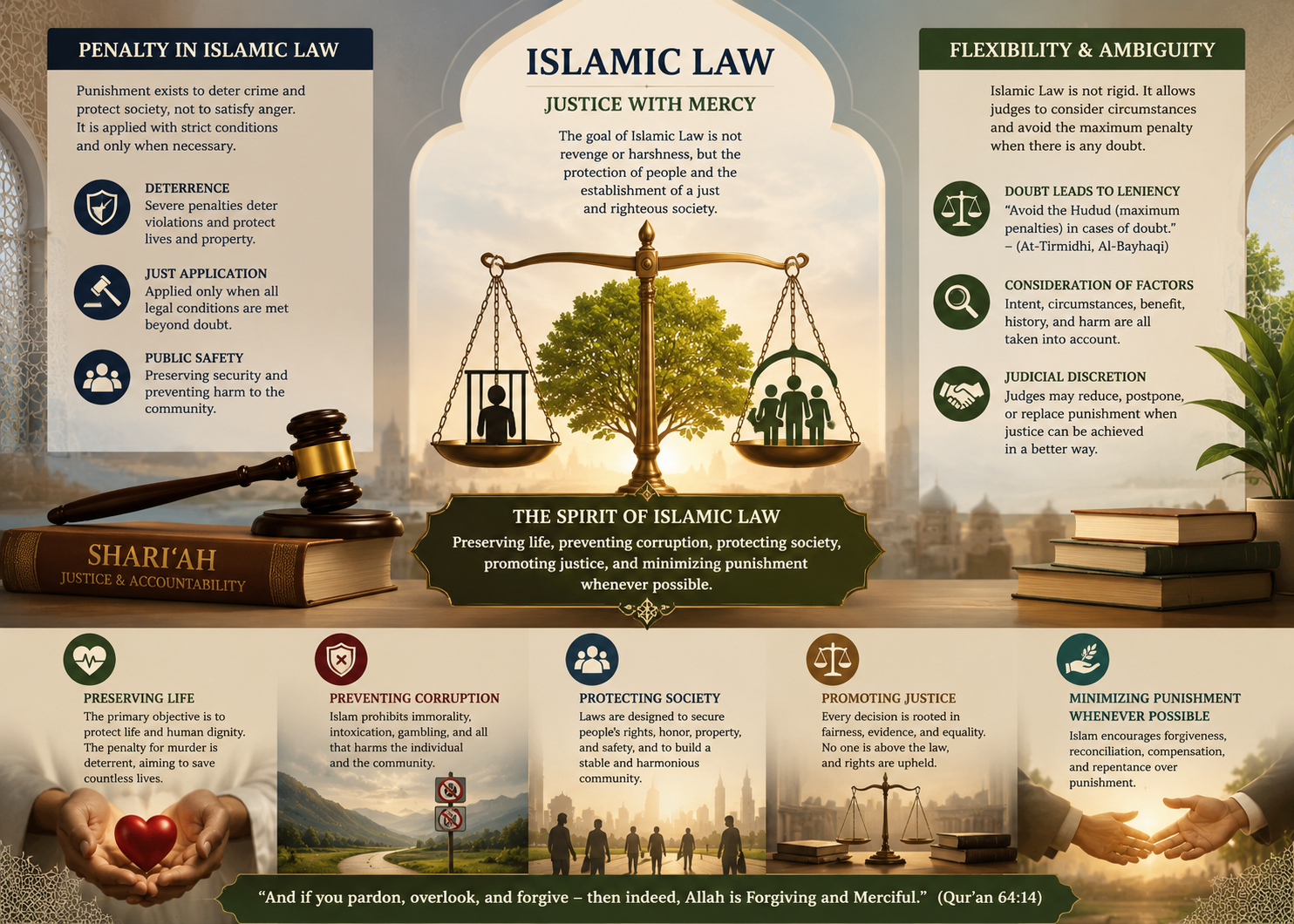
The psychological effect of punishment on human behavior can also be observed in Islamic Law. While the maximum penalty for professional theft is hand-cutting, this does not mean that every theft automatically results in such a punishment. Islamic jurisprudence places numerous conditions, restrictions, and evidentiary requirements before the maximum sentence can ever be considered.
Judges may also impose alternative penalties such as imprisonment, fines, or other corrective measures. Historically, the existence of severe penalties functioned primarily as a deterrent, discouraging organized theft and habitual criminal behavior.
Likewise, the penalty for accidental killing in Islamic Law is capital punishment. The underlying wisdom behind the severity of this sentence is the preservation of life itself. The Qur’an states:
“And there is life for you in al-Qisas (the law of equal retaliation), O people of understanding, so that you may become mindful.”
— Qur’an 2:179
Human beings naturally fear death. Therefore, establishing a law that subjects intentional killers to equal punishment serves as a powerful deterrent against murder and helps protect innocent lives. In this sense, the objective of the law is not vengeance, but the preservation of society, justice, and human life itself.
Sentence Executions
The maximum penalty prescribed by Islamic Law is not applied in every case. In matters of theft and robbery, for example, the punishment of hand-cutting is subject to strict conditions and careful judicial consideration. Factors such as criminal history, intent, motive, and circumstances surrounding the offense are all taken into account. In some cases, no punishment is imposed at all—such as when a person steals food out of extreme hunger or to prevent death.
A well-known example from the era of Caliph Umar ibn al-Khattab illustrates this principle. A man brought his servant before Umar and demanded that the servant’s hand be cut off for theft. Umar asked the servant whether he had taken from his master’s property. When the servant admitted the act, Umar asked why he had done it. The servant explained that his family had nothing to eat. The master acknowledged that this claim was true.
After further questioning, Umar concluded that the master himself was responsible for failing to provide his servant with adequate food, shelter, and care. Rather than punishing the servant, Umar ordered the master to fulfill his servant’s needs properly. Thus, the accusation against the servant became a case against the master. This example demonstrates that Shari’ah is fundamentally rooted in justice, fairness, and social responsibility.
Historical Context of Hand-Cutting in Arabia
It is important to recognize that the practice of hand-cutting was not originally introduced by Islam, but was already a recognized legal custom in pre-Islamic Arabia, and that no hand was to be cut if the value of the stolen property was less than a quarter of a dirham, a Persian coin commonly used at the time. The Qur’an addressed people within their historical, cultural, and social realities, engaging existing legal practices while placing them within a broader framework of justice, restraint, and public welfare.
Dr. Adnan Ibrahim has further explained that matters related to worldly governance and social administration—particularly those not regarded as immutable acts of worship or core articles of faith—may be reconsidered if alternative penalties can achieve equal or better outcomes in preserving justice, security, and social order. In this understanding, the higher objectives of Islamic law, including the protection of society and the prevention of harm, remain central to Islamic legal thought.
Alternatives to Capital Punishment
Although the prescribed penalty for intentional murder in Islamic Law is death, the Islamic judicial system also allows reconciliation, financial compensation, and forgiveness depending on the circumstances. In this way, Islamic Law provides alternatives to capital punishment and encourages mercy whenever possible.
The Qur’an states:
“O you who believe, prescribed for you is legal retribution for those murdered: the free for the free, the enslaved for the enslaved, and the female for the female. But if the offender is pardoned by the victim’s family, then reconciliation should be pursued with fairness and payment made with kindness. This is a concession and a mercy from your Lord.”
— Qur’an 2:178
Accordingly, the victim’s family may seek legal punishment, accept financial compensation, or grant a pardon. The Qur’an repeatedly encourages forgiveness and reconciliation:
“But if you pardon, overlook, and forgive, then indeed Allah is Forgiving and Merciful.”
— Qur’an 64:14
Regarding the transformative power of forgiveness, Dr. Ingrid Mattson of Hartford Seminary observed:
“Because forgiveness itself is an act that frees the people who have been harmed from the sense of anger and victimization, it empowers them by giving them some control over the situation through the act of forgiveness.”
Flexibility and Ambiguity
Flexibility in determining penalties is an integral feature of Islamic Law. Punishment is not applied mechanically, but is evaluated according to the nature and circumstances of the offense. Factors such as the severity of the harm, the offender’s background, intent, and the crime’s repetition all play an important role in determining the appropriate sentence. Furthermore, the Prophet Muhammad ﷺ said:
“Avoid applying the maximum penalties (hudud) whenever there is ambiguity or doubt.”
— al-Tirmidhi and al-Bayhaqi
Because punishment in Islam is intended primarily as a deterrent and a means of preserving justice, judges may reduce or avoid the maximum penalty when the objectives of the law have already been achieved. Likewise, they may increase penalties in cases requiring greater protection of society. The Islamic judicial tradition contains many examples illustrating the law’s concern for fairness, restraint, and justice.
One remarkable example demonstrating the Prophet’s extraordinary sensitivity toward justice involved a Jewish man named Zayd ibn al-Luthah. He approached Prophet Muhammad ﷺ, grabbed him firmly by his clothing, and accused him of delaying repayment of a debt. Umar ibn al-Khattab, standing nearby, drew his sword and said: “O Messenger of Allah, permit me to strike off his head.”
The Prophet ﷺ replied calmly:
“No, Umar. Instead, you should advise him to ask politely for his rights, and advise me to repay him properly.”
Although the debt was not yet due until the following week, the Prophet instructed Umar to repay Zayd the eight dinars owed to him and to add an additional eight dinars as compensation for frightening him. When Umar asked why the extra payment was necessary, the Prophet replied:
“Because you frightened him with your threat.”
Zayd then declared:
“Our scriptures describe the expected Prophet as a man of immense patience. I only wished to test your character, and I now bear witness that you are truly the Prophet of God.”
Such moral restraint reflects the profound compassion, patience, and ethical integrity that characterized the Prophet Muhammad ﷺ.
The Spread of Vice
Islam establishes strong safeguards to limit the spread and normalization of vice within society. Publicizing immorality often leads to its acceptance, and widespread acceptance of corruption contributes to social decay. The Qur’an teaches:
“Do not even approach unlawful sexual relations, for it is indeed an immorality and an evil path.”
— Qur’an 17:32
And:
“O you who believe, intoxicants, gambling, idolatrous practices, and divining arrows are impurities from the work of Satan, so avoid them that you may succeed.”
— Qur’an 5:90
The Qur’an further states:
“Say: My Lord has forbidden immoralities, whether open or hidden, as well as sin and oppression without right.”
— Qur’an 7:33
And:
“Indeed, those who love to spread immorality among the believers will have a painful punishment in this world and the Hereafter.”
— Qur’an 24:19
For this reason, Islamic Law made accusations of adultery extremely difficult to prove. The Qur’an requires four eyewitnesses to the act itself before legal punishment may be considered:
“The woman and the man guilty of unlawful sexual intercourse—flog each of them with one hundred lashes… And those who accuse chaste women but do not produce four witnesses—flog them with eighty lashes and reject their testimony thereafter.”
— Qur’an 24:2–4
The requirement of four direct witnesses created an extraordinarily high legal threshold, making public prosecution of such cases rare while simultaneously discouraging gossip, slander, and invasive public discussion of private sins. False accusations carried severe penalties of their own.
Thus, while Islamic Law imposed strict moral standards, it also strongly protected personal dignity and privacy. The legal barriers surrounding adultery cases discouraged the spread of sexual gossip and prevented immorality from becoming normalized in society. At the same time, Islam left the door wide open for private repentance, moral reform, and personal transformation without public humiliation.
Justice and the Protection of Society — Not the Pursuit of Punishment
The ultimate purpose of Islamic Law is not harshness or the excessive application of penalties, but the preservation of justice, safety, and social order. Avoiding punishment whenever possible is itself considered desirable within the Islamic legal tradition.
A famous example from the Prophet’s lifetime illustrates this principle. A woman known as al-Ghamidiyyah came to Prophet Muhammad ﷺ and confessed to adultery, asking to be purified from her sin. The Prophet repeatedly attempted to turn her away, asking whether perhaps she had only kissed or touched the man rather than committed intercourse. When she insisted upon her confession, he postponed judgment.
Upon learning that she was pregnant, the Prophet instructed her to return after giving birth. After she returned with the child, he told her to nurse the infant for two years before coming back again. Only after all concerns regarding the child’s welfare had been resolved was the legal penalty carried out.
Several modern scholars, including Dr. Adnan Ibrahim, have questioned the authenticity of this narration and argued that the Qur’anic punishment for adultery is flogging rather than stoning. Dr. Ibrahim considered the narration historically unreliable. Understanding the “Radiant Path,” one easily concur with Dr. Ibrahim.
Even if the account were accepted as authentic, it would still demonstrate that the Prophet ﷺ was not eager to impose punishment. His repeated delays reflected Islam’s deep concern for preserving life, protecting children, and allowing every opportunity for mercy and reconsideration. He neither imprisoned the woman nor ordered a search for her partner.
Thus, even where severe penalties existed, the spirit of Islamic Law remained centered upon preserving life, preventing corruption, protecting society, promoting justice, and minimizing punishment whenever possible.
Recommended Posts
نشأة الانقسام السني الشيعي
January 9, 2026

The Emergence of Sectarian Identity: Rethinking the Genesis of the Sunni-Shia Divide
December 8, 2025
The Best School of Fiqh is the Qur’an – Gulf Talk
October 16, 2025
I was recommended this blog by my cousin. I am not sure whether this post is written by him as
nobody else know such detailed about my trouble. You’re incredible!
Thanks!
The author is given at the top of the page of the article. Below is the link anyway, but thanks for your comment.
https://www.islamic-study.org/about-us/about-the-author/